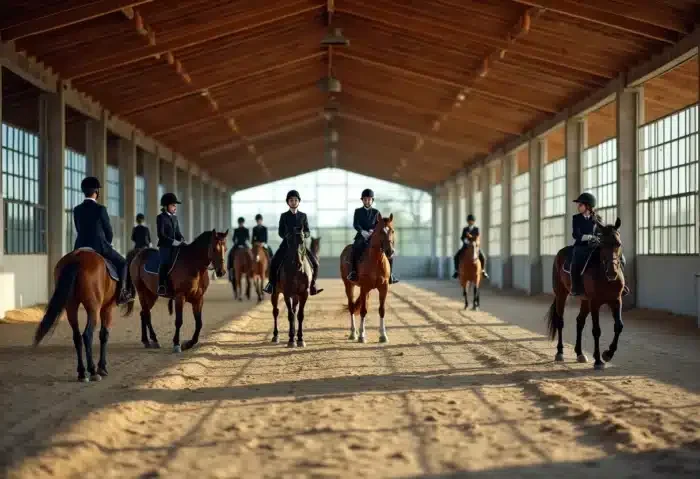
Equestrianism is not limited to riding a horse. Succeeding in this discipline requires rigorous training and constant learning. Some institutions play a fundamental role in this journey.
National stud farms, for example, offer essential resources and training for riders and breeders. Similarly, recognized riding schools, such as the Cadre Noir de Saumur, impart unique know-how and emphasize discipline and respect for the horse. Thanks to these institutions, enthusiasts can acquire the necessary skills to excel and stand out in this demanding practice.
Key Institutions in Equestrianism in France
To succeed in the world of equestrianism, one must turn to institutions that have proven themselves in training and support for riders. The Fédération Française d’Équitation (FFE) plays a central role in this field. It counts no less than 30 different equestrian disciplines, offering a wide range of possibilities for enthusiasts. The FFE, through its tool FFE SIF, allows for optimal management of activities and competitions, thus facilitating the lives of riding centers and riders.
Riding Centers: Pillars of Training
Riding centers, such as the Écuries de l’Odon run by Adeline Nicolas, are essential places for learning and practicing equestrianism. Located in Normandy, these stables provide an ideal setting for progress, with a dedicated team including Johan, Adeline’s partner, Malvina, a passionate intern, and Kévin, a groom. Rachel, for her part, ensures the continuity of activities by substituting for Adeline when necessary.
- Adeline Nicolas: Director of the Écuries de l’Odon
- Johan: Adeline’s partner and key support
- Malvina: Intern in training
- Kévin: Groom
- Rachel: Adeline’s substitute
The Société Hippique Française
The Société Hippique Française (SHF) is another major entity. It is dedicated to breeding and promoting sport horses in France. Through its actions, it supports breeders and young horses, thus ensuring a promising future for tomorrow’s riders. The SHF organizes competitions and events that serve as springboards for horses and their riders, contributing to the excellence of French equestrianism.
These institutions, through their commitment and actions, are the guarantors of the quality and sustainability of equestrianism in France. They enable riders to train, progress, and compete with the best, while ensuring the well-being of the horses.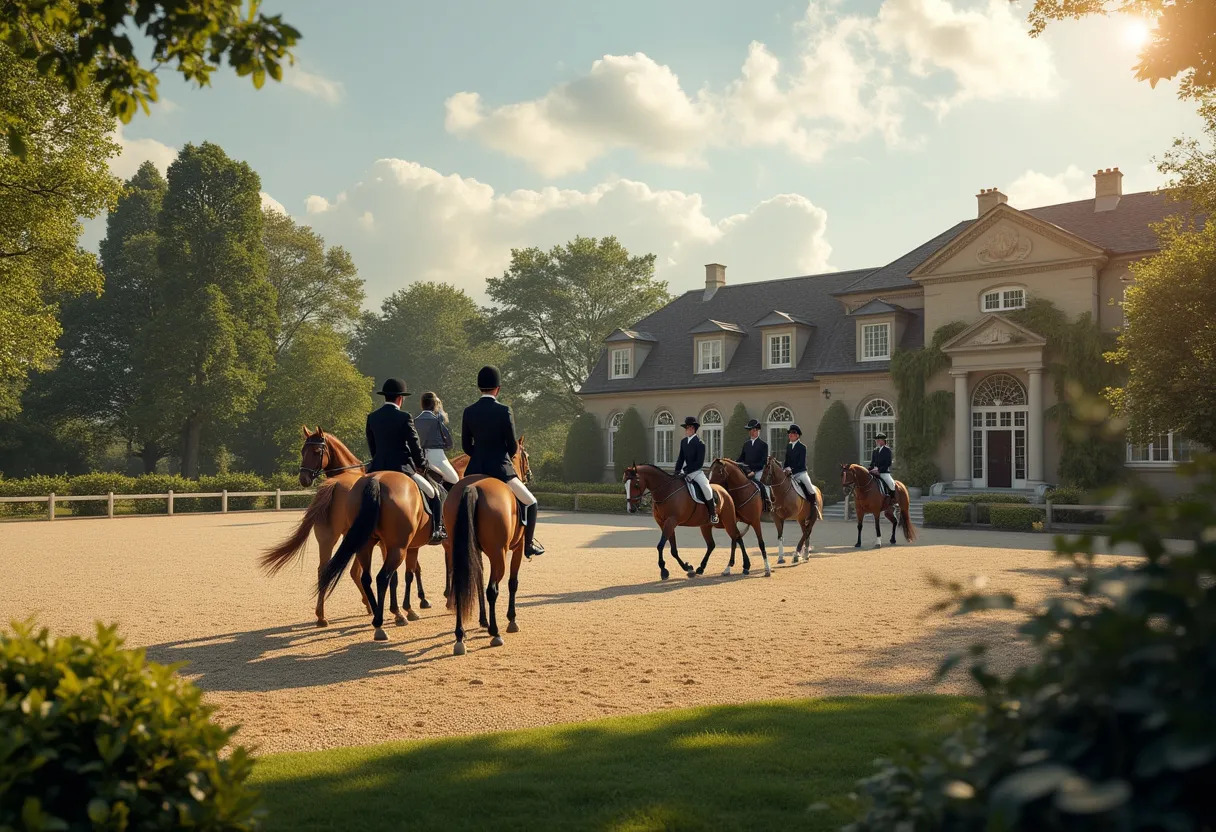
Essential Training and Certifications for Success
To excel in the field of equestrianism, training and certifications are pivotal elements. The Fédération Française d’Équitation (FFE) offers several levels of gallops, ranging from gallop 1 to gallop 9, allowing riders to validate their progressive skills.
Federal Gallops
- Gallop 1 to 4: Learning the basics and safety.
- Gallop 5 to 7: Mastery of advanced techniques and preparation for competition.
- Gallop 8 and 9: Refinement and expertise for riders wishing to become professionals.
Instructor and Monitor Diplomas
For those aspiring to teach, the State Diploma of Youth, Popular Education and Sport (DEJEPS) and the Professional Certificate of Youth, Popular Education and Sport (BPJEPS) are essential. The DEJEPS allows for overseeing equestrian activities and training riders up to a high competition level. The BPJEPS, on the other hand, is a more general diploma, but essential for becoming a riding instructor.
Continuing Education
To stay at the forefront of knowledge and techniques, riders and instructors must engage in continuing education. These trainings include improvement workshops, seminars on new training approaches, and courses on managing the horse’s physical condition.
The Quinta Cavaluz, for example, offers immersion days for riders of all ages, providing a unique opportunity to immerse oneself in a professional equestrian environment.
These certifications and training allow riders to effectively prepare for the high demands of competition and equestrian teaching.